
Making 1+1=3: Team Structure at Mayo Clinic
Why Purpose-Driven Structure Is the First Ingredient in exponential outcomes

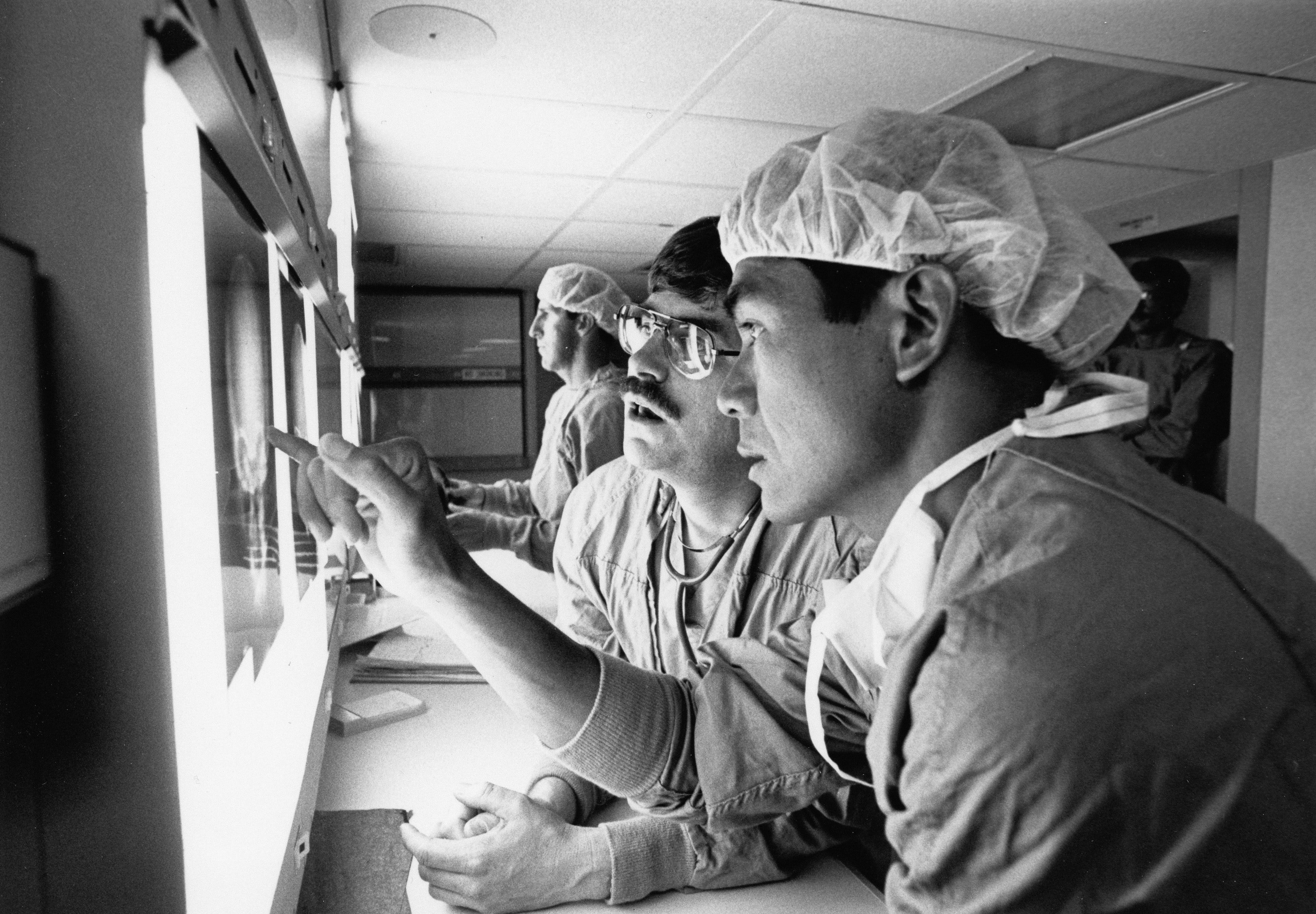
Photo Credit: Navy Medicine, Unsplash
At a Glance: Most organizations rely on cross-functional teams to solve complex problems. Yet many of those teams are assembled rather than designed. Exponential outcomes — the kind where 1+1 feels closer to 3 — rarely emerge from talent or collaboration alone. They appear when teams are purpose-built around a shared objective and structured to allow perspectives to combine in the right way. Structure is not the whole equation. But without it, intelligence aggregates rather than compounds.
Most of our interactions with the medical system are straightforward.
Imagine you wake up with a fever. Something feels off, but not unfamiliar, so you stop by urgent care. A physician listens, asks a few clarifying questions, runs a quick test, and sets a course for treatment. The exchange is efficient. The interaction is focused and clear. The system moves with a rhythm that exudes confidence.
These common ailments are the diagnoses the system was built to recognize with speed and reliability. And most of the time, it works remarkably well.
Until the symptoms fall outside the normal range.
Prefer to Listen? This podcast-style exchange is created specifically for this article’s content, delivered in a wholly unique way for additional insights!
Occasionally — much like in business — the established system struggles to produce clear or effective results. Costs rise. Friction increases. Opinions multiply. The operating environment senses that something is wrong but cannot easily identify, let alone resolve, what is ailing it.
In medicine, that might look like a fever that lingers without explanation or a rash paired with neurological signals that don’t seem to connect. Tests return inconclusive, and one specialist follows another. Each is thoughtful and well-practiced in their field, but each offers a narrow perspective grounded in focused expertise.
And yet still the larger picture never quite comes together.
The discomfort that follows is not simply medical. It’s structural. The system that performs well under familiarity begins to feel fragmented under ambiguity. Not because the individuals lack intelligence or ability, but because the architecture of the team was built for something else.
Designing Fit for Purpose Teams
It is often at this point in medical diagnosis that a different configuration enters the picture. For our unsolved mystery, that frequently means turning to a system like Mayo Clinic, an institution long associated with diagnosing rare and complex conditions when other systems come up short.
It is tempting to attribute that reputation to extraordinary expertise. But physicians across institutions are trained in the same science and operate within the same biological constraints. Doctors everywhere remain limited by what is medically known and what has yet to be discovered.
So if it is not individual excellence, then what explains the difference?
The answer lies in something far less glamorous than talent. It lies in how individual expertise is assembled for collective intelligence.
An organization, as the name implies, is the configuration of people around a purpose. And configuration shapes not only what outcomes are possible, but how efficiently and effectively they can be produced.
Mayo is structured differently than urgent care. It is not designed primarily for speed and throughput. It is designed to integrate perspectives early and deliberately when confronting complexity. Specialists still gather evidence, run tests, and apply years of experience. But their insights converge in parallel rather than being handed off sequentially before early interpretations become fixed and difficult to unsettle.
For patients navigating rare or complex conditions, success is not defined first by cure but by clarity. Medicine cannot accelerate beyond scientific limits. Instead, success often begins with coherence — a diagnosis that integrates symptoms across disciplines rather than fragmenting them across specialties. The structure exists to make that integration more likely.
What is less obvious is how frequently this same structural pattern appears inside organizations.
Redefining Organization
Inside firms, initiatives stall in ways that feel strangely familiar. A strategy underperforms despite thoughtful planning. A product struggles even though capable teams are working diligently. A transformation loses momentum not for lack of effort, but because signals conflict and interpretations diverge.
Leaders respond rationally. They assemble a cross-functional team to diagnose and solve the problem. So far, so good.
The room fills with capable people representing different vantage points. Finance outlines economic constraints. Operations highlights execution realities. Marketing brings customer insight. Engineering explains feasibility and tradeoffs. Each contribution is valid. Each reflects deep expertise.
And yet novel solutions remain elusive.
As progress slows, the instinct is to dig in deeper. Meetings lengthen. Documents multiply. The organization appears collaborative and engaged, but clarity does materialize.
At some point, an uncomfortable question surfaces: if so much talent is present, why does insight feel scarce?
Cross-functional groups are frequently constructed around representation — ensuring that relevant stakeholders are included and downstream consequences are considered. That instinct is sensible. It protects against blind spots and political friction.
But equal representation is not the same as purposeful representation.
When teams are assembled to balance constituencies, they often optimize for fairness rather than fitness. Seats are distributed evenly across functions. Voices are included to signal coverage. The result feels inclusive. But it rarely produces synthesis.
A team built for coverage but rooted in politics may achieve consensus. But a team built for structural integration may achieve clarity. The two are not the same.
Structure determines whether intelligence aggregates.
Homogeneous and Heterogeneous Designs
A homogeneous structure — teams organized around shared training or functional alignment — excels at repeatability and speed. It minimizes friction and accelerates execution at scale. For routine and predictable work like treating the flu, this design is efficient and often indispensable.
A heterogeneous structure intentionally blends distinct perspectives for the purpose of surfacing competing assumptions and connecting signals that would otherwise remain isolated. When organized around a clearly defined objective, this configuration can reveal insights no single lens could generate alone.
But heterogeneous teams are much harder to build and sustain, which is where we start to see Mayo’s uniqueness.
Researchers have long shown that we can look at the same facts and draw different conclusions. Those differences in perspective create friction. Coordination costs rise and conversations stall. Without a clearly shared mission and active management, disagreement can devolve into defensiveness or drift toward compromise. It is often easier to retreat to familiar structures than to remain inside that tension long enough for synthesis to occur.
Designing for compounding insight therefore requires more than assembling diverse expertise. It requires the discipline to select for fitness over fairness, and the courage to manage productive conflict in service of a shared objective.
Structure alone does not guarantee breakthrough. But without it, breakthrough is unlikely.
Designing for the Work in Front of You
If structure is a design choice, then one of the quiet disciplines of leadership is knowing when to change it.
In medicine, a strong primary care physician understands this instinctively. When a problem is routine, they act decisively. Familiar patterns narrow the field, and speed is a virtue. The system works because it does not overcomplicate what is already clear.
But when symptoms resist explanation, the approach shifts. The physician widens the aperture. They seek a second opinion. They assemble additional expertise — not through permanent committee, but temporary expertise to uncover what no single vantage point can see alone.
The objective remains constant. The configuration changes.
Inside organizations, the same discipline is available at every level. While core structures built for speed and repeatedly rightly are locked down, temporary, purpose-built teams can be assembled formally or informally. When ambiguity or innovation demands integration, simply walking across the office to understand another’s perspective is invaluable.
When the core function is well designed, it carries most of the load. Temporary, heterogenous teams appear when the system encounters something it was not built to solve. However, if an organization finds itself relying on them constantly, it may be an early signal that the standing structure is misaligned with its primary purpose.
Neither homogenous nor heterogenous structures are inherently superior. Each is built for something different. The difference lies in recognizing that configuration is not inevitable.
The Design Beneath the Decision
Most team structures are inherited long before they are questioned. Over time, they begin to feel fixed. Departments form. Reporting lines persist. Meetings recur. The configuration becomes background rather than choice.
But structure is never neutral. It reflects an assumption about what kind of problems matter most.
Trouble begins when the nature of the work shifts, but the design remains unquestioned.
Exponential outcomes do not emerge from collaboration alone, nor from expertise in isolation. They appear when structure, purpose, and interaction align — when the way people are assembled matches the problem they are trying to solve.
That alignment rarely happens by accident.
References
Berry, L. L., & Seltman, K. D. (2008). Management lessons from Mayo Clinic: Inside one of the world’s most admired service organizations. McGraw-Hill.
Centola, D. (2018). How behavior spreads: The science of complex contagions. Princeton University Press.
Christakis, N. A., & Fowler, J. H. (2009). Connected: The surprising power of our social networks and how they shape our lives. Little, Brown and Company.
Galton, F. (1907). Vox populi. Nature, 75, 450–451. https://doi.org/10.1038/075450a0
Gittell, J. H. (2009). High performance healthcare: Using the power of relationships to achieve quality, efficiency and resilience. McGraw-Hill.
Greiner, L. E. (1998). Evolution and revolution as organizations grow. Harvard Business Review, 76(3), 55–68.
Hackman, J. R. (2002). Leading teams: Setting the stage for great performances. Harvard Business School Press.
Hong, L., & Page, S. E. (2004). Groups of diverse problem solvers can outperform groups of high-ability problem solvers. Proceedings of the National Academy of Sciences, 101(46), 16385–16389. https://doi.org/10.1073/pnas.0403723101
Kozlowski, S. W. J., & Ilgen, D. R. (2006). Enhancing the effectiveness of work groups and teams. Psychological Science in the Public Interest, 7(3), 77–124. https://doi.org/10.1111/j.1529-1006.2006.00030.x
Page, S. E. (2007). The difference: How the power of diversity creates better groups, firms, schools, and societies. Princeton University Press.
Salas, E., Sims, D. E., & Burke, C. S. (2005). Is there a “big five” in teamwork? Small Group Research, 36(5), 555–599. https://doi.org/10.1177/1046496405277134
Schein, E. H. (2010). Organizational culture and leadership (4th ed.). Jossey-Bass.
West, M. A. (2012). Effective teamwork: Practical lessons from organizational research (3rd ed.). BPS Blackwell.
Woolley, A. W., Chabris, C. F., Pentland, A., Hashmi, N., & Malone, T. W. (2010). Evidence for a collective intelligence factor in the performance of human groups. Science, 330(6004), 686–688. https://doi.org/10.1126/science.1193147
That was a lot. If you’re still here, you’ve likely begun to see the pattern.
Once you start noticing structure as a design choice rather than a default, it is difficult to ignore. Organizations known for exponential outcomes often look less mysterious when viewed through this lens. The throughline is rarely luck or charisma. More often, it is configuration.
Consider SpaceX.
Reusable rockets were once dismissed as impractical, if not impossible. Space-based data centers still sound like science fiction. Yet these are precisely the kinds of problems SpaceX was built to confront. And is solving.
Its teams are intentionally structured to integrate disciplines that traditionally operate in isolation — propulsion, materials science, software, telemetry, manufacturing. Roles are curated not for equal representation, but for fitness to the problem at hand. Feedback loops are tight. Assumptions are tested quickly. Friction is expected and managed.
That structure doesn’t just allow SpaceX to move quickly. It allows the company to attempt problems that would overwhelm more traditional designs.
This is not accidental. It is configuration aligned with purpose.
If you’re curious, I explored SpaceX’s intentional design choices in more depth here.