
Part 3: How Microsoft Rewired Its Culture for Curiosity
How Satya Nadella transformed a culture of competition into one of curiosity, and what it reveals about how complex change spreads at scale.

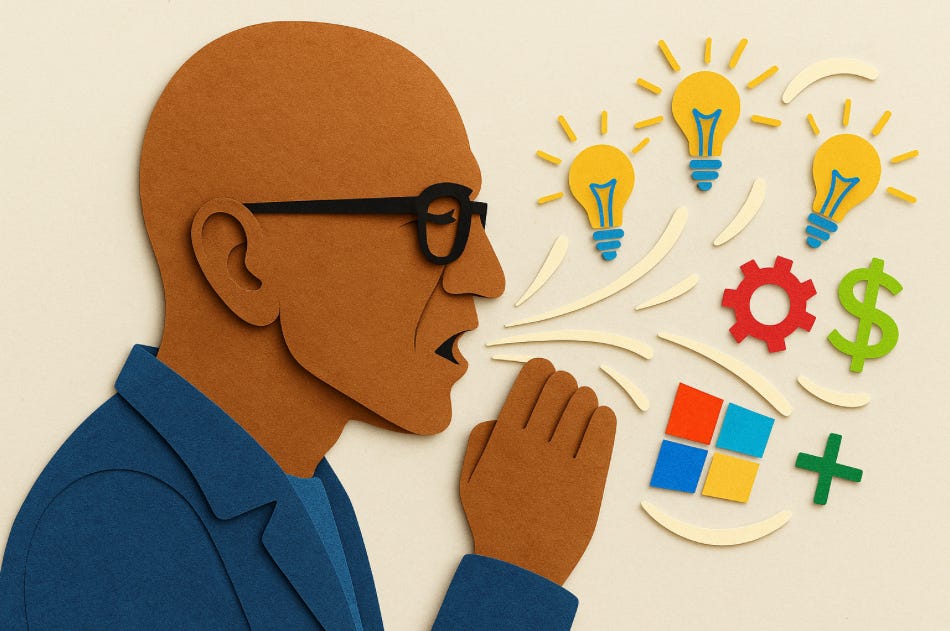
At a Glance: When Satya Nadella became CEO in 2014, Microsoft was a paradox: profitable, yet paralyzed by internal rivalry. Rather than reorganize or mandate culture change, Nadella quietly redesigned how learning spread. He seeded empathy and curiosity through trusted relationships, repeated modeling, and shared ownership — conditions that mirror sociologist Damon Centola’s theory of complex contagion. The result was a network-driven transformation that rewired not only Microsoft’s operating rhythm but its cultural DNA.
In 2014, Microsoft looked successful from the outside but, as reports would later suggest, it was stuck on the inside.
Revenue was steady. Windows and Office still dominated their markets. But the energy that once defined the company had faded. Inside Redmond, teams competed more than they collaborated. Divisions guarded their turf. Brilliant ideas died in committee. Employees called it the “know-it-all” culture. The organization was so busy proving it was right that it stopped learning altogether.
Then came Satya Nadella.
When he stepped in as CEO, Nadella didn’t talk about product pipelines or market share. He talked about empathy. It sounded almost naïve at the time — an engineer leading with emotion in a company famous for intensity. But Nadella saw something most leaders miss: cultural decay isn’t fixed by policy. It’s repaired through human connection.
So he started listening. He shared stories about his son’s disability and how it taught him to see people, not just problems. He encouraged managers to do the same. Over time, those acts of vulnerability became acts of modeling. Curiosity began to spread not through town halls or slogans, but through quiet reinforcement in one-on-one conversations, team meetings, and manager coaching circles.
What emerged was one of the most remarkable corporate comebacks in modern history.
Culture Shifts When Behavior Reinforces Itself
Most leaders try to change culture by defining values and broadcasting them widely. The assumption is that if people understand what’s changing and why, they’ll get on board.
But understanding doesn’t drive adoption. Reinforcement does.
Damon Centola’s research on complex contagions shows that behaviors requiring personal or identity-level change don’t spread through single exposures (like the flu might, for instance). Instead, they spread through multiple exposures to that idea, such as seeing the same behavior modeled again and again by people you respect until it feels safe enough to try.
Every person has a threshold, which is the number of trusted exposures they need before belief turns into behavior. Some people need one credible example. Others need five. That’s why change moves unevenly across organizations. It’s also why momentum feels slow until, suddenly, it isn’t: once enough thresholds are crossed, adoption cascades almost exponentially.
That’s how Nadella’s empathy-driven approach worked. He didn’t rely on charisma or compliance. He created a system of repetition (multiple exposures). Managers were encouraged to model “learn-it-all” behaviors, share what they were curious about, and celebrate learning from failure. Senior leaders were coached to echo the same themes in reviews and product planning sessions. The behavior spread not as a directive, but as a self-reinforcing pattern until it became the new normal.
This is what most change models miss, whether it’s a new process or an international merger. Culture doesn’t shift because a leader declares new values. It shifts when enough people begin acting differently together. Nadella’s brilliance wasn’t in his message. It was in designing the conditions for that message to multiply.
How Curiosity Became Contagious
Nadella understood that transformation couldn’t be handed down. It had to spread.
So rather than issuing a new set of cultural commandments, he began with a single phrase that would become Microsoft’s north star: growth mindset. Borrowed from psychologist Carol Dweck, the idea was deceptively simple: replace “know-it-all” with “learn-it-all.” But what mattered wasn’t the slogan. It was how often, and by whom, it was repeated.
Leaders modeled it first. In executive meetings, Nadella asked his team what they had learned that week. When someone didn’t know an answer, he framed it as a moment of curiosity, not weakness. Those small shifts changed the social calculus. Admitting uncertainty stopped being risky; it started signaling alignment with the new norm.
From there, the behavior cascaded. Microsoft built “manager circles” where peers discussed what growth mindset looked like in practice. Performance reviews were retooled to emphasize learning and collaboration over internal competition. And communication rituals, like Yammer threads, celebrated lessons learned from failed projects and amplified the message laterally, not hierarchically.
Each repetition was a nudge. Each nudge, a new exposure.
Centola’s work calls this a reinforcement loop: behaviors that spread only after people encounter them multiple times through trusted and credible ties. Nadella didn’t need everyone to believe the new values immediately; he just needed the right nodes in the network to start modeling curiosity publicly. Once those individuals gained traction, others would follow.
Within a few years, Microsoft’s old internal rivalries began to loosen. Cross-divisional collaboration that was once a rarity became a source of pride. The cultural signals had flipped. People stopped asking, “Who gets credit?” and started asking, “What can we learn?”
And with that shift, performance followed. By 2023, Microsoft had more than tripled its market capitalization, overtaken Apple as the world’s most valuable company, and restored its reputation as a place where innovation and humanity coexist. *As of this writing, Apple has regained the spot with a $3.99 trillion valuation; Microsoft follows with around $3.84 trillion valuation. Their positions have changed frequently.
This wasn’t a turnaround powered by structure. It was a rewiring of social norms and proof that when behaviors reinforce one another through trust and repetition, culture becomes self-sustaining. And can accelerate a transformation.
Designing for Reinforcement
Nadella’s genius wasn’t in discovering a new management method. It was in realizing that culture is a network property. In other words, culture is related more to how humans connect than how they work. And thus, culture behaves much like a living system.
The lesson is that culture change can’t be imposed. It has to be activated. And activation doesn’t come from better top-down directives or improved training (though they are necessary); it comes from designing environments where desired behaviors can reinforce themselves. Part 2 of this series walks through exactly how we designed such an environment in practice.
That starts with knowing where trust and credibility already live. Organizational Network Analysis, when paired with behavioral insight, can show who people turn to when they lose clarity and control. These are the “social bridges” who can make new ideas feel both credible and safe.
But identifying those people isn’t always straightforward. As Bloomberg’s Jo Constanz recently wrote, many firms are turning to internal “influencers” to accelerate adoption, especially around AI. Yet in most cases, those influencers are either self-nominated volunteers or appointed by leadership. Both approaches risk bias: leaders tend to choose people who look or think like them, while volunteers may overestimate their reach. The result can backfire — the so-called “boss’s pet” effect (I didn’t know that was a real thing until researching this article) — where an appointed champion is trusted by executives but mistrusted by everyone else.
That’s where ONA becomes invaluable. Influence, like beauty, is in the eye of the beholder. Network analysis allows organizations to measure it objectively by identifying who employees already consider credible. By activating those authentic connectors, companies can seed transformation programs that spread two to four times faster than traditional top-down approaches. When the right people speak, thresholds fall faster.
The second step is repetition. Change rarely takes hold after one exposure. The firm has to model it publicly, then make space for others to do the same, such as through team rituals, peer stories, and visible learning moments. At Microsoft, those loops were built into the operating rhythm: manager circles, feedback rituals, and even product reviews became vehicles for cultural reinforcement.
The third step is control. People don’t embrace change they feel forced to mimic. They adopt what they can make their own. Microsoft’s teams weren’t told how to live a growth mindset; they were invited to interpret it. The result was not compliance but creativity where local adaptations kept the culture alive instead of uniform.
Taken together, these mechanisms of trust, repetition, and control form a blueprint for what Damon Centola calls complex contagion. They turn abstract values into social signals and single acts into shared norms.
The central conceit: leaders can’t dictate culture. But they can design the conditions for it to spread.
The Social Architecture of Change
Every organization has its share of strategy documents, vision decks, and leadership mantras. Most fade quietly into the background not because people disagree with them, but because the message never becomes behavior.
Nadella’s Microsoft shows what happens when it does.
Culture didn’t shift because the CEO gave better speeches or launched a new performance system. It shifted because people began seeing the same behaviors modeled again and again by those they trusted most. Each exposure reduced the perceived risk of acting differently. Each act of vulnerability made the next one easier. Over time, curiosity became the norm, not the exception.
That’s the essence of complex contagion: change doesn’t spread because leaders demand it. It spreads because people see enough proof that it’s what gets rewarded (which, among the five or so core definitions of culture, this is the common thread).
For leaders, the implication is profound. The future of transformation from AI and remote work to global integrations, won’t be driven by better plans. It will be driven by better networks.
About the Author: Jason is a behavioral economist and founder of 3Fold Collective, an organizational design and performance firm helping leaders diagnose and reshape cultural dynamics. Visit 3FoldCollective.com to discover more.
References
Centola, D. (2018). How behavior spreads: The science of complex contagions. Princeton University Press.
Constanz, J. (2025, November 12). How to get workers to use AI: Let coworkers teach them. Bloomberg. https://www.bloomberg.com/news/articles/2025-11-12/how-to-get-workers-to-use-ai-let-coworkers-teach-them
Dweck, C. S. (2006). Mindset: The new psychology of success. Random House.
Nadella, S. (2017). Hit refresh: The quest to rediscover Microsoft’s soul and imagine a better future for everyone. Harper Business.
Harvard Business Review. (2022, April). The CEO of Microsoft on rediscovering the company’s soul. https://hbr.org/podcast/2017/09/microsofts-ceo-on-rediscovering-the-companys-soul
Fortune. (2024, March). Satya Nadella has made Microsoft 10 times more valuable in his decade as CEO. Can he stay ahead in the AI age? https://fortune.com/2024/05/20/satya-nadella-microsoft-build-generative-ai-openai/
Whoa! You’re still here?! Normally, this is where I’d point you to another article in the canon. But this time, I want to invite you back to Part 1: The Science of Change. Now that you’ve seen the impact in practice, the theory reads differently. You may notice something that’s easy to miss the first time through: every person has a threshold for adoption, which is the number of trusted exposures they need before a new behavior feels safe enough to try. And only credible carriers of an idea can lower that threshold. (There’s a whole story about how people become credible in the first place… we’ll get to that someday.) That’s where ONA comes in. It identifies those carriers at scale and is the key to turning a good idea into a contagious one.
Part 1: The Science of Change

At a Glance: This is the first in a three-part series exploring how ideas and behaviors spread, and how that invisible process shapes an organization’s ability to evolve successfully and at speed. The series examines why 70 percent of change efforts fail, not because leaders choose the wrong strategy, but because they underestimate the social systems th…