
The Realization Factor: What Turns AI Spend Into AI Return
AI spend has hit the income statement. The return still hasn’t. What sits between them is a design problem.


At a Glance: While corporate spending on artificial intelligence has surged, most organizations struggle to see a tangible return on investment because they prioritize simple adoption over fundamental workflow redesign. Economic gains often vanish through fragmented time savings, increased oversight burdens for managers, and the unpredictable nature of AI competence. To capture true value, leaders must move beyond mere experimentation and focus on augmenting specific roles to remove operational bottlenecks.
For two years, there wasn’t really an AI question so much as an AI answer that everyone agreed to. The technology was becoming inevitable and standing still meant you were falling behind. The smart move was to put the tools in people’s hands and let value follow. And, for this reason, most companies adopted AI for the simplest reason: everyone else was.
Then the bills arrived, and they were startling. In 2025, enterprises poured an estimated $37 billion into generative AI, more than triple the year before.1 Uber reportedly spent its annual AI budget in four months; another burned through $500 million of tokens in a single month.2 Heavy usage became a badge of honor — “tokenmaxxing,” with Meta and Amazon ranking their biggest users on leaderboards until even OpenAI’s Sam Altman called the mounting costs “a huge issue.”2
Those early worries about cost were not misplaced but highlighted that we were probing the wrong question. It was not so much about the spend, but about the return on that spend. CFOs demanded ROI; no one had named the mechanism that produced it.
Listen Instead: For anyone who would rather listen than read, I created a short AI-generated podcast version of this article. It was built specifically from this piece, so it stays close to the argument here: why AI ROI often looks better in theory than it does on the income statement, where the value leaks out, and what leaders can do to raise the realization factor.
The reflex has been to cut the spend: caps, retired leaderboards, cheaper models swapped in to shave the invoice. Some of that is discipline — you don’t need a sledgehammer to hang a picture. But it gives the game away. Companies are choosing the tool before defining the job, treating a design problem as a procurement one. A cheaper invoice for automating the wrong work solves nothing.
I’ve argued before that the AI economy moves through four layers: spend, use, absorption, and realization. Spend is the easy one; it hits the income statement whether or not any benefit is realized. So the question is no longer whether we’re using AI; the bills prove we are. It’s how much of that spending comes back, which makes the invoice not the end of the AI story, but the beginning.
Adoption was never the hard part
By ordinary measures, AI has arrived: Stanford’s 2026 AI Index puts organizational adoption at 88%, yet fewer than one in ten organizations has scaled it in any single function.3 MIT’s Project NANDA found that roughly 95% of generative-AI pilots produced no measurable P&L impact.4The bar has critics, but McKinsey’s survey agrees from the inside: more than 80% report no tangible effect on earnings.5
The adoption push did real work, however, it eased fear and made experimentation normal. But experimentation is episodic, and episodic use shows up as activity and spend, almost never as something a CFO can bank. Buying the right hammer is not the same as hanging the picture.
The realization factor
Here is the concept I put in front of CFOs and COOs to help shape the AI discussion: the realization factor: the share of AI’s productivity gain that actually converts into economic value. Not the promise. The part that reaches the ledger. What it highlights is that not all projects are equal.
Take the most common misunderstanding: time savings. A tool saves an analyst ten minutes here and there, such as through a tidier email or a faster recap. But scattered minutes are nearly impossible to reinvest; they leak back into the day as slack. An hour freed in one block is worth far more, however, and is the difference between compiling a report and acting on it. Same time saved, radically different value.
This is why AI business cases disappoint. The pilot team reports hours saved, but the budget office sees nothing come out the other side. The COO sees no change in throughput, the CHRO watches roles shift and anxiety spike, and the CIO watches usage and the bill climb in unison. Everyone is watching a different layer of the same system, and no one has named the rate at which one converts into the next.
Whether a given use of AI converts into economic value, then, correlates with how fragmented time savings are. You can see the value grow with increasing concentration:
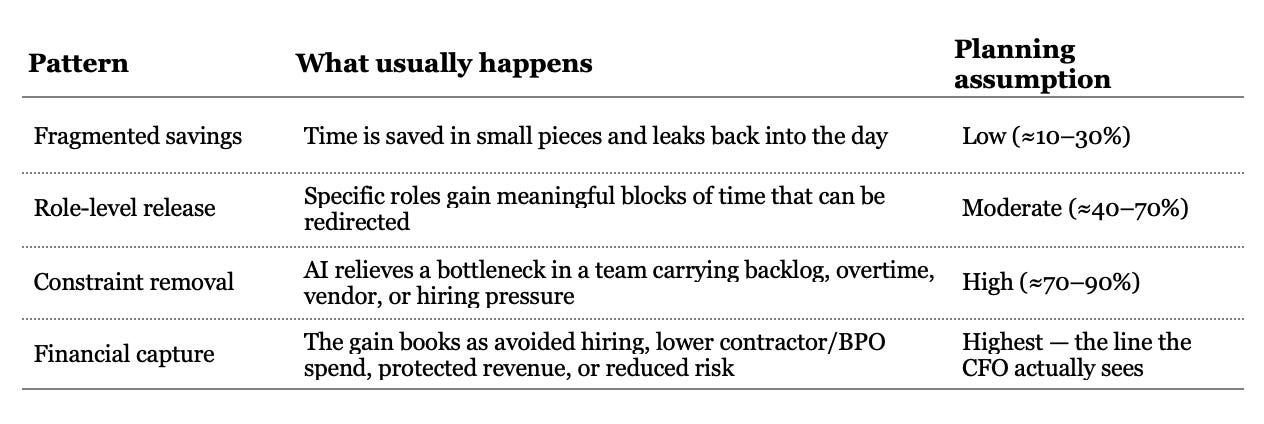
Word of caution: treat these as hypotheses to test against your own data, not benchmarks. Come in low and you’ve likely deployed ahead of your readiness; come in high and redesigning adjacent workflows may yield more. The point isn’t the decimal, it’s asking how large a haircut your existing workflows force on the gross number.
Where the gain leaks out
If concentration raises the factor, three leaks pull it back down.
The first is task shifting. An AI draft isn’t a finished good; someone has to check it, and that checking is where much of the promised savings evaporates. And it won’t fix itself soon: in Stanford’s 2026 Index, inaccuracy was the most-cited AI risk, named by 74% of firms.3 As models improve the check gets lighter, but someone stays accountable. HBR reports the burden is landing on middle managers, piling validation and error-catching onto a layer already under pressure.6 The gain doesn’t vanish so much as relocate: save developers ten hours, hand managers four back in review. Still a gain, just smaller than the demo promised.
The second results from the jagged frontier. In a field experiment with BCG consultants, those using a frontier model were faster and better on tasks inside its competence, and more likely to be wrong just outside it.7 The boundary isn’t marked; the model answers confidently on both sides, so the same person gets opposite results with no signal which is which. The gain is real only where someone can tell where the tool’s competence ends — a judgment that has to be built.
The third almost no one counts: invisible slack. Time saved that no one recaptures doesn’t become output — it becomes idle capacity and quietly evaporates.
Every leak has the same fix, and it isn’t a better model. It’s augmentation: redesigning the task so human and machine share it, with clear lines about where to trust the tool, where to test it, and where judgment stays human. That’s what separates the layers. Adoption puts the tool in someone’s hands. Augmentation redraws the work around it. Absorption is when the redrawn work holds — when norms, trust, and decision rights actually change. Realization is when it reaches the income statement. A project’s factor depends on which rung it has climbed.
Not all work is AI-worthy
Redesign is the fix, but it comes second. The first discipline is selecting what to redesign at all. Most disappointing projects were lost at the choosing, picked because they demoed well, not because they could pay. A demo shows whether AI can do a task; it says nothing about whether doing it returns anything.
An AI-worthy project is one built to survive those leaks, and each leak, turned around, is a test. Can a person verify the output faster than doing the work by hand? Does it sit inside the tool’s competence, where right and wrong are legible? Does the freed time arrive in redeployable blocks rather than scattered minutes? And have you traced where the work goes next, so a saving on one desk doesn’t resurface as a burden on another? Run those tests and the field narrows fast, which is the point. What clears is work where gross productivity and realized value sit close together.
Why the factor stays low — and how it rises
The factor is low not because the tools are weak but because the operating model around them was never rebuilt. When the work is genuinely redesigned, the returns are real: across more than 5,000 support agents, AI access lifted productivity by 14%, with the largest gains for the least-experienced by spreading top performers’ tacit knowledge to everyone else.8 The organizations seeing results, BCG finds, are set apart less by tool access than by strategic clarity; in other words, knowing where AI fits, what to stop doing, and where freed capacity should go.9
And realization is only realization against an expectation. A gain the COO books as a throughput win can read as failure to a CFO who wanted cost out. So when leaders haven’t agreed on which expectation AI serves, even real gains land as disappointment.
When it does arrive, realization lands as released time, added capacity, better quality, or protected revenue, and each one should resolve to just two things: more revenue or less cost. That is the whole destination of the realization factor: the gross gain, minus every haircut, arriving as one of those two.
“But it’s early”
The strongest objection is that it’s simply early. That low realization is a lag, not a ceiling. There’s truth in it: buying capability before you can fully use it holds an option on what comes next. But an option only holds value if you’re building the capacity to exercise it. Spend without absorption isn’t value; it’s decay. Redesign the work and you’re buying a real option; treat adoption as the finish line and you’re paying to stand still faster.
The question the bill is actually asking
The invoice did one useful thing: it turned the AI question from theater into economic possibility — and that’s measurable. The move now isn’t to spend less or downgrade the model. It’s to raise the realization factor deliberately: mapping where AI changes the work versus where it merely adds verification, redesigning those workflows with clear human and machine roles, and building the conditions that let the benefit land. That’s the work of a focused readiness assessment and a disciplined pilot, not another company-wide rollout.
The market has proven you can spend on AI. What it hasn’t settled — what only you can settle, inside your own workflows — is how much comes back. That was never going to show up in a model release or a lower per-token price. It gets built, layer by layer, out of the way people and machines are taught to work together.
Jason L. Zimmerman is the founder of 3Fold Collective, a consulting firm focused on the behavioral side of complex change. 3Fold helps organizations turn strategy into execution by diagnosing how work, incentives, networks, and leadership behaviors shape outcomes, especially in large efforts like AI adoption, workforce transformation, and operating model change.
Citations
1 Menlo Ventures, “2025: The State of Generative AI in the Enterprise”: enterprises spent an estimated $37 billion on generative AI in 2025, up from ~$11.5 billion in 2024 (≈3.2x year over year). https://menlovc.com/perspective/2025-the-state-of-generative-ai-in-the-enterprise/
2 The Economist, “Companies are scrambling to curtail soaring AI costs” (June 14, 2026): Uber exhausting its annual AI budget in four months; a firm reportedly spending ~$500M on tokens in a month; “tokenmaxxing” and internal usage leaderboards at firms including Meta and Amazon; the shift toward spending caps and cheaper models; Sam Altman describing customer costs as “a huge issue.” https://www.economist.com/business/2026/06/14/companies-are-scrambling-to-curtail-soaring-ai-costs
3 Stanford HAI, The 2026 AI Index Report: organizational AI adoption reached 88% (generative AI used in at least one business function at 70% of organizations), while fewer than 10% of organizations have fully scaled AI in any single function; inaccuracy was the most-cited AI risk (74% of respondents), and measured hallucination rates across 26 leading foundation models ranged from 22% to 94%. https://hai.stanford.edu/ai-index/2026-ai-index-report
4 MIT Project NANDA, The GenAI Divide: State of AI in Business 2025 (July 2025): despite an estimated $30–40 billion in enterprise spending, roughly 95% of generative-AI pilots produced no measurable P&L impact, and only ~5% of custom/integrated tools reached production with significant value. Based on ~300 public deployments, 52 interviews, and 153 executive surveys; note that its success definition (measurable KPIs and ROI at six months post-pilot) has been debated. Report via MIT Project NANDA; accessible coverage: https://fortune.com/2025/08/18/mit-report-95-percent-generative-ai-pilots-at-companies-failing-cfo/
5 McKinsey, “The state of AI: How organizations are rewiring to capture value” (2025 Global Survey): a large majority use AI in at least one function, yet more than 80% report no tangible enterprise-level EBIT impact from generative AI. https://www.mckinsey.com/capabilities/quantumblack/our-insights/the-state-of-ai-how-organizations-are-rewiring-to-capture-value
6 Julia Shin & Sandra J. Sucher, “AI Adoption Is Overloading Your Middle Managers,” Harvard Business Review (June 26, 2026): drawing on 18 interviews with partners, managers, and junior consultants at two major consulting firms, the authors find that as senior leaders expand AI’s scope and junior staff report large productivity gains, the work of validating AI output, catching its errors, and coaching teams onto the tools falls to middle managers — who absorb it under unchanged or heavier delivery pressure and without formal support. https://hbr.org/2026/06/ai-adoption-is-overloading-your-middle-managers
7 Dell’Acqua, McFowland, Mollick, et al., “Navigating the Jagged Technological Frontier,” Harvard Business School Working Paper 24-013 (2023): consultants using a frontier model completed more tasks, worked faster, and produced higher-quality work inside the model’s frontier, but were less likely to reach the correct answer on a task outside it. https://www.hbs.edu/faculty/Pages/item.aspx?num=64700
8 Erik Brynjolfsson, Danielle Li & Lindsey R. Raymond, “Generative AI at Work,” NBER Working Paper No. 31161: across ~5,000 customer-support agents, AI access raised productivity by ~14% on average, with the largest gains for the least-experienced workers, as the system disseminated the best agents’ tacit knowledge. https://www.nber.org/papers/w31161
9 BCG, “AI at Work: Why Strategy Matters More Than Tools” (2026): strategic clarity is a stronger predictor of measurable impact than tool access; ambiguity is the biggest hindrance to successful AI transformation. https://www.bcg.com/publications/2026/ai-at-work-why-strategy-matters-more-than-tools
Read next: How complex change spreads
If this piece is about why AI value fails to reach the ledger, the next question is more human: how does a change like AI actually spread through an organization? Spoiler: not through one heroic town hall, one training session, or one very confident email from leadership.
AI adoption, like all complex change, moves through trust, networks, social proof, local experiments, and the quiet signals people use to decide whether something is real or just this quarter’s initiative. That is the science underneath uptake, resistance, and the awkward middle where everyone says they are “using AI” but nobody is quite sure what changed.
Part 2: How Complex Change Spreads

At a Glance: Most transformations fail not because the strategy is wrong, but because leaders misread how change travels through an organization. This case study shows what happens when social science meets strategy — when change is treated as a system to be engineered rather than a message to be managed. Drawing on network science and behavioral econom…